I selected the canonical GAR artifact in the digest-selection commit. The change puts the repository and immutable digest into Helm values, aligns the negative fixtures with the same registry and includes root workflow/action changes in release triggers.
A successful build produces a candidate. Git desired state selects what Argo attempts to run, and admission decides whether a matched request can proceed. This patch is the selection step; it adds no automated promotion service.
Before and after the engineering change
Before
Mutable or outdated desired identity
After
Reviewed digest selected in Helm
Evidence boundary
Manual promotion; no automated GCP release selector.
Manual promotion; no automated GCP release selector.Text equivalent and limits
Mutable or outdated desired identity
Reviewed digest selected in Helm
Manual promotion; no automated GCP release selector.
Read the labeled relationships as the stated contract. Optional connections are dashed and explicitly labeled; comparisons do not imply a sequential handoff. This figure explains inspected code or recorded observations, not current cloud execution.
The retained values select sha256:32a90d832fdf76794fa5477e42e1fdcec28c9eb6e0deee48ad466d1f7d9fc563. The Deployment template joins the repository and digest with an @, so runtime selection is an immutable image reference rather than a mutable deployment tag.
The PR, build and signing system does not update those values automatically. The baseline release workflow has no cluster write, Argo API call or Git desired-state update. A maintainer selecting a candidate in Git is a separate authority from the workflow producing it. Review is the intended process; this patch does not prove a remote required-approval rule.
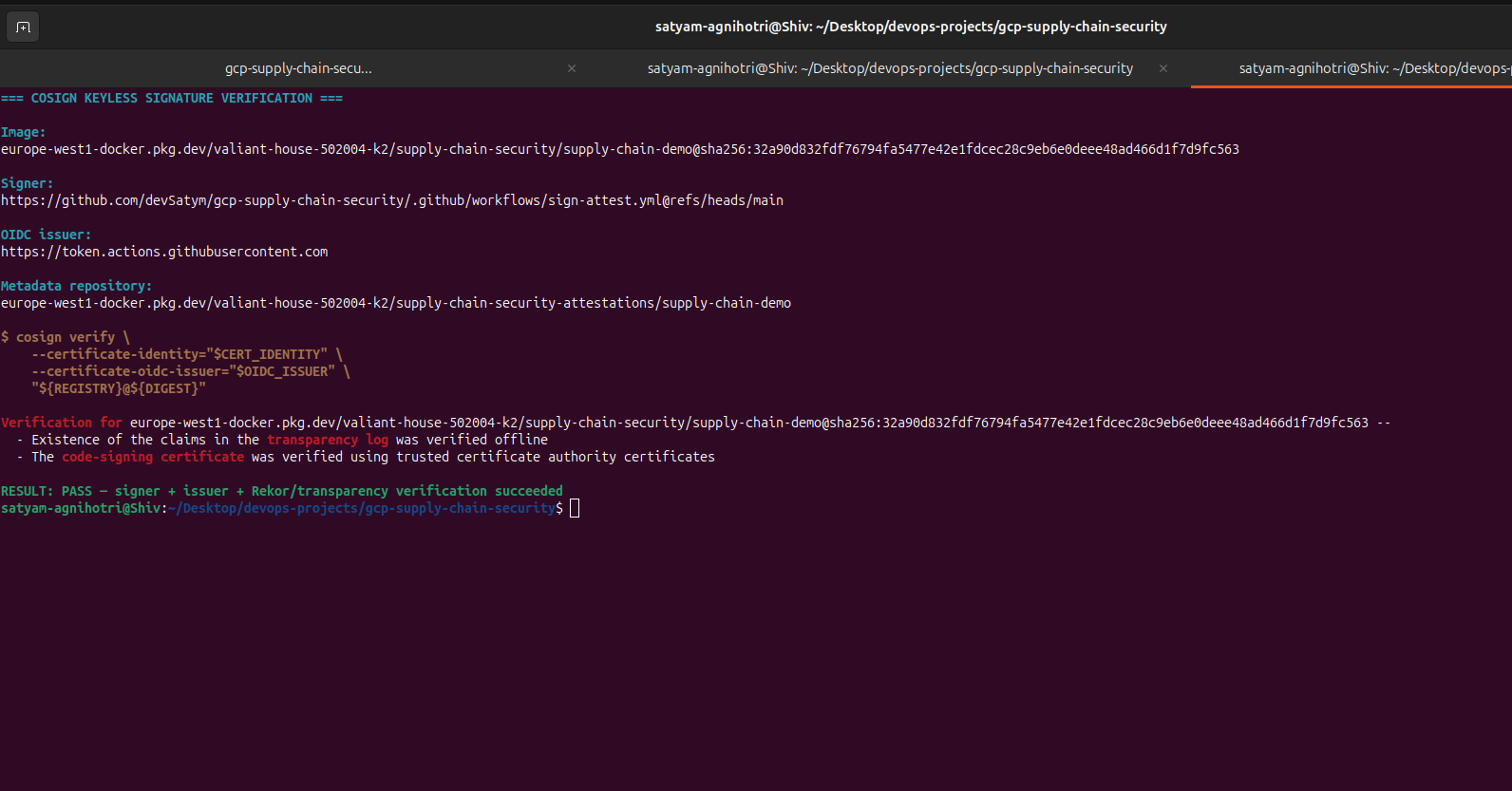
The original Cosign verification capture belongs to the selected 32a90d… artifact family. It is relevant context for that artifact and must not be substituted for the later strict-CI a0073f8f… output.
Recorded capture · Captured keyless signature verification succeeded. Signature verification succeeded for the pictured 32a90d artifact. Collection: .
Evidence boundary: This standalone signature verification does not display SBOM or provenance predicate validation. The browser does not reauthenticate the capture.
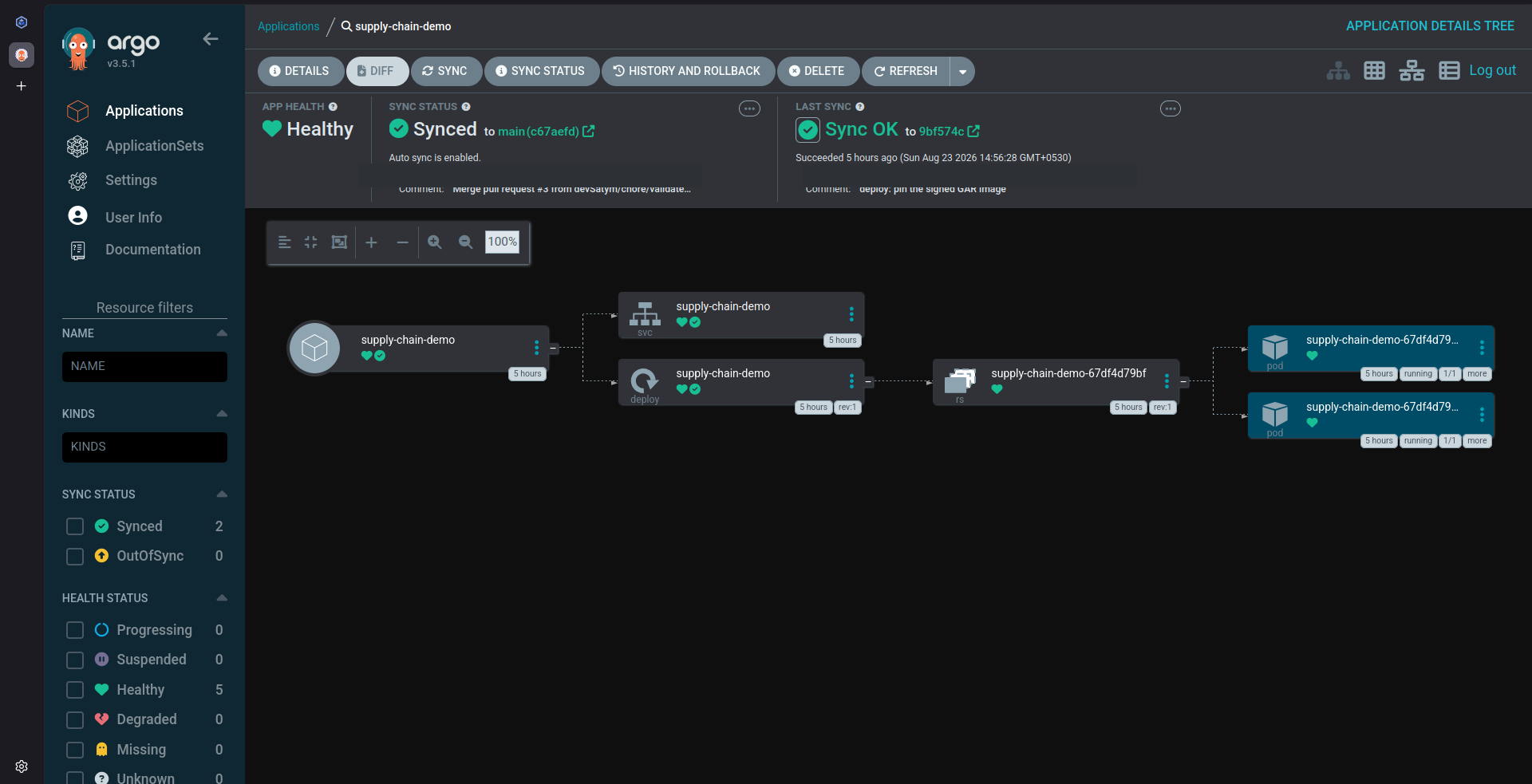
The Argo capture records current sync main(c67aefd) and last successful sync 9bf574c as different fields. It reports Healthy and Synced, with running Pod nodes.
Recorded execution · accepted
The pictured application was Healthy and Synced to canonical main at capture time.
Recorded result: Capture shows Healthy, Synced to main(c67aefd), Sync OK to 9bf574c, two running Pod nodes.
Argo reconciliation captured on 2026-08-23; current sync c67aefd and last-sync 9bf574c are separate observations. Select the image for full resolution.
Key limitation: Healthy/Synced describes captured reconciliation, not cryptographic verification by Argo.
Transcript and provenance
Expected in this setup: Argo reconciles the selected Helm release and reports healthy workload resources.
Historical GCP, europe-west1; current environment not checked · observed 2026-08-23 · source revision c67aefdb7e140edf94213284bc2cb73a0b1d5a46
Selected visible labels:
APP HEALTH Healthy
SYNC STATUS Synced to main(c67aefd)
Auto sync is enabled.
LAST SYNC Sync OK to 9bf574c
Succeeded 5 hours ago (Sun Aug 23 2026 14:56:28 GMT+0530)
Two Pod nodes: Running 1/1
Full limitations
Healthy/Synced describes captured reconciliation, not cryptographic verification by Argo.
Current sync revision and last-sync revision are different visible fields; neither is automatically the artifact build revision.
The picture does not independently establish policy revision or all admitted image fields.
Visual review of original capture. Collection capture date attributed to docs/my-validation/README.md; this task did not rerun its cloud experiment. Unmodified original. Application status, public source revisions and timestamps retained; no user-info contents or credential visible.
That is reconciliation and resource-health evidence. Argo itself is not the cryptographic image verifier. The trusted admission capture supplies a separate server dry-run result, followed by live-read output:
Recorded execution · accepted
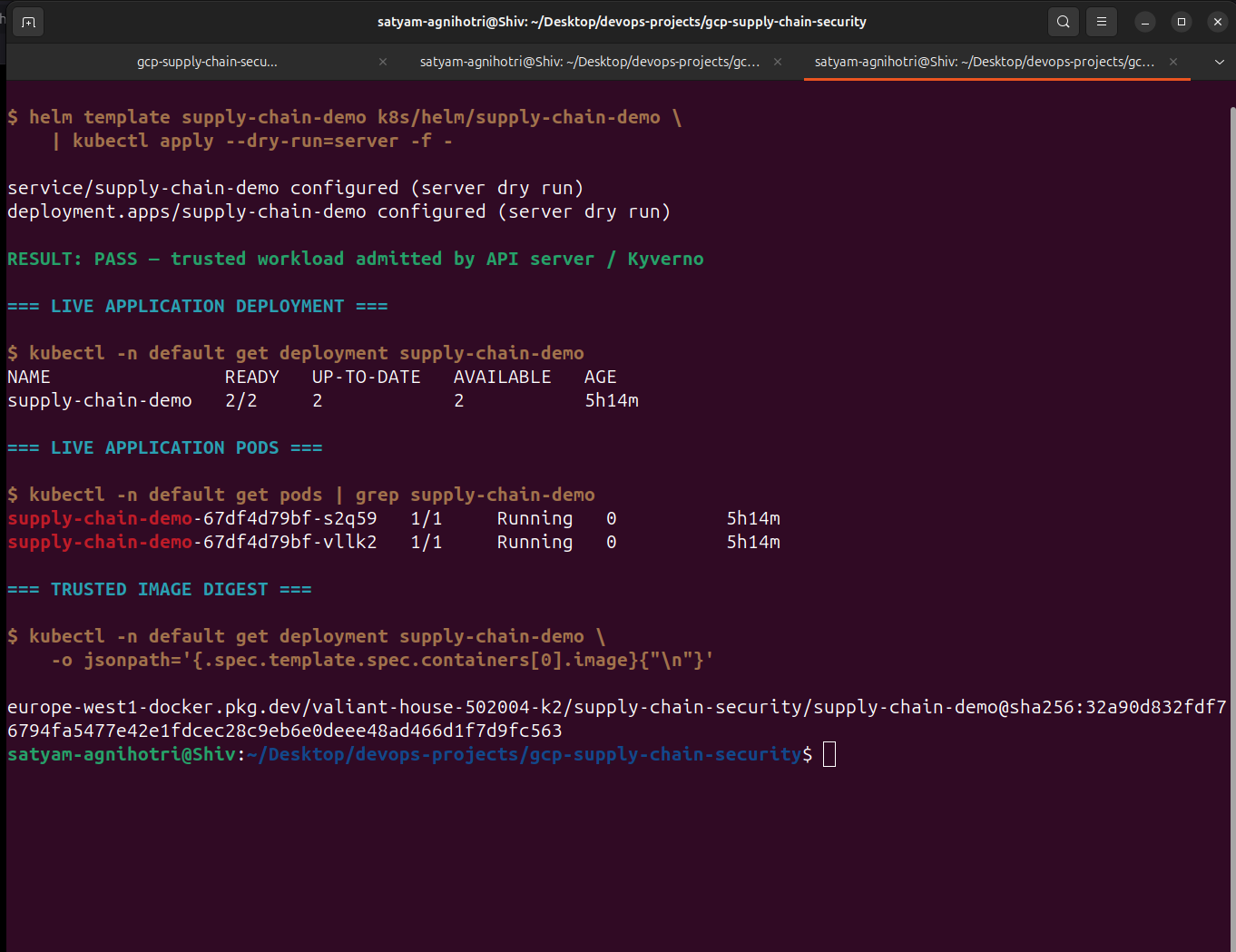
The captured trusted Helm release passed API-server dry run; the application separately had two available replicas.
Recorded result: Service and Deployment configured under server dry run; live Deployment listed 2/2 ready and available.
The signed release passes server dry-run; a separate query reports two available replicas. Select the image for full resolution.
Key limitation: Server dry run does not itself create the observed live replicas; the capture includes separate live-read commands.
Transcript and provenance
Expected in this setup: A workload using the signed selected digest is accepted in the matched namespace.
Historical GCP, europe-west1; current environment not checked · observed 2026-08-23 · source revision unknown; not inferred from the documentation baseline
Selected visible output:
service/supply-chain-demo configured (server dry run)
deployment.apps/supply-chain-demo configured (server dry run)
RESULT: PASS - trusted workload admitted by API server / Kyverno
NAME READY UP-TO-DATE AVAILABLE AGE
supply-chain-demo 2/2 2 2 5h14m
TRUSTED IMAGE DIGEST
sha256:32a90d832fdf76794fa5477e42e1fdcec28c9eb6e0deee48ad466d1f7d9fc563
Full limitations
Server dry run does not itself create the observed live replicas; the capture includes separate live-read commands.
The source commit that built this image and the exact installed policy revision are not established by this screenshot.
Acceptance is historical, not proof of today's controller or workload status.
Visual review of original capture. Collection capture date attributed to docs/my-validation/README.md; this task did not rerun its cloud experiment. The original screenshot is approved for display at the owner’s explicit request for all evidence images and subsequent Cloudflare publication. Original terminal metadata remains visible. No additional pixel redaction was selected or applied. The selected transcript omits incidental prompts without changing the recorded result.
Server dry run does not create those live replicas. Nor does the screenshot establish the source commit that built the image or the exact installed policy revision.
Historical source status attributes the 32a90d… build/sign run to e369771… and run 32629860698. The owner validation README also records a successful pipeline at 9bf574c/run 32630716371. Those are separate recorded events.
The later strict-CI capture identifies source 27a94b0 and artifact a0073f8f…. The source status deliberately retains the earlier selected digest in Helm. Later verification code cannot retroactively prove that an older build ran the same assertions. For that change, read exact verification with its own evidence identity.
Align the negative fixture without overstating coverage
This commit changes both negative fixture registry references and their signed ordinary-container selection. In the mixed-image fixture and init fixture, the unsigned image is an init container next to a signed regular image.
The recorded ev-init-deny result covers those two server dry runs. It does not establish an unsigned ordinary sidecar or ephemeral-container update test. The container-field explanation preserves that distinction.
Manual selection makes the desired artifact visible as a Git change and allows a newer build to remain a candidate while the chosen version stays selected. It also creates a handoff that requires deliberate review and correct identity bookkeeping.
The useful lesson is to retain four things separately: artifact build identity, selected digest, Git reconciliation revision and admission result. One green status or shortened commit label cannot stand in for the whole chain.