Sign the digest with a workflow identity
Anyone can create an image and attach an arbitrary claim to it. The verifier needs to distinguish a statement from the accepted workflow from a statement made by an unrelated identity. Keyless signing supplies cryptographic evidence tied to the signing job’s GitHub identity, rather than a stored signing key supplied by the repository.
- GitHub OIDC
A cloud-audience token is exchanged through federation.
- GCP service account
Short-lived IAM permissions allow registry access.
- GitHub OIDC
The signing exchange identifies the workflow subject.
- Fulcio + Rekor
Cosign verifies issuer, subject and transparency evidence.
- GitHub OIDC GCP service accountGCP federation exchange
- GitHub OIDC Fulcio + RekorSigstore identity exchange
Text equivalent and limits
- Cloud path: GitHub token exchanges through federation for short-lived GCP service-account access.
- The CI cloud account publishes/reads registry content under IAM.
- Signing path: the workflow obtains keyless identity for the canonical sign-attest.yml at refs/heads/main.
- Fulcio certificate and Rekor evidence support Cosign verification against subject and issuer.
Read the labeled relationships as the stated contract. Optional connections are dashed and explicitly labeled; comparisons do not imply a sequential handoff. This figure explains inspected code or recorded observations, not current cloud execution.
Which identity is accepted
Section titled “Which identity is accepted”Sign and Attest authenticates to the registry, installs Cosign, and calls cosign sign --yes on repository@digest. The setup action defaults to Cosign v2.4.1. The expected certificate issuer is:
https://token.actions.githubusercontent.comThe expected subject is:
https://github.com/devSatym/gcp-supply-chain-security/.github/workflows/sign-attest.yml@refs/heads/mainThe reusable signing workflow is the identity. deploy.yml orchestrates the run, while verify.yml consumes statements. Neither substitutes for the signing identity. CI verification and Kyverno both require the actual signing workflow subject and issuer.
Artifact and metadata storage
Section titled “Artifact and metadata storage”- Application image
Immutable tags protect the reviewed artifact store.
- Digest D
Content identity binds references to the exact manifest.
- Cosign metadata
Separate mutable store permits signature/attestation metadata updates.
- Signed statements
Verification checks claims about D rather than trusting a mutable tag.
- Application image Digest Dcontent address
- Cosign metadata Signed statementssigned claim objects
- Digest D Signed statementssubject digest binding
Text equivalent and limits
- Immutable tags protect the reviewed artifact store.
- Content identity binds references to the exact manifest.
- Separate mutable store permits signature/attestation metadata updates.
- Verification checks claims about D rather than trusting a mutable tag.
Read the labeled relationships as the stated contract. Optional connections are dashed and explicitly labeled; comparisons do not imply a sequential handoff. This figure explains inspected code or recorded observations, not current cloud execution.
The application repository is configured with immutable tags. Cosign v2’s legacy signature and attestation indexes use metadata tags that must be updated as statements are appended. The workflow therefore supplies COSIGN_REPOSITORY for a separate mutable metadata repository, and admission specifies that same repository location.
Mutable metadata storage does not make a valid signature applicable to arbitrary image content. The cryptographic statements remain bound to the image digest. It does create an availability dependency: metadata can become missing or inaccessible independently of the image. A registry pull succeeding is therefore insufficient evidence that admission can read every required claim.
What a signature establishes
Section titled “What a signature establishes”Successful verification establishes that the relevant statement matches the digest and accepted certificate identity/issuer under the verifier’s Sigstore trust expectations. The policy names Rekor at https://rekor.sigstore.dev; transparency supports inspection of signed claims. It does not independently audit the source, scanner decisions, or builder environment.
This workflow subject includes the mutable ref main, not a commit-pinned workflow implementation. If an authorized or compromised actor changes that trusted workflow, the resulting job can retain the accepted identity. A valid signature from that identity does not establish that the workflow ran benign code. See shared trust dependencies.
Failure and evidence
Section titled “Failure and evidence”Wrong identity strings cause otherwise valid statements to fail the contract. The identity consistency test checks consumers for the canonical workflow suffix and the admission entrypoint. It is a useful local drift guard, not proof that Sigstore or registry services are available.
The standalone capture below shows cosign verify accepting the selected 32a90d… artifact against the canonical signing workflow and GitHub issuer. Its output reports certificate verification and offline verification of the transparency proof. The screenshot does not show SPDX or provenance predicate validation. It is a separate observation from the later a0073f8f… CI claim-verification capture.
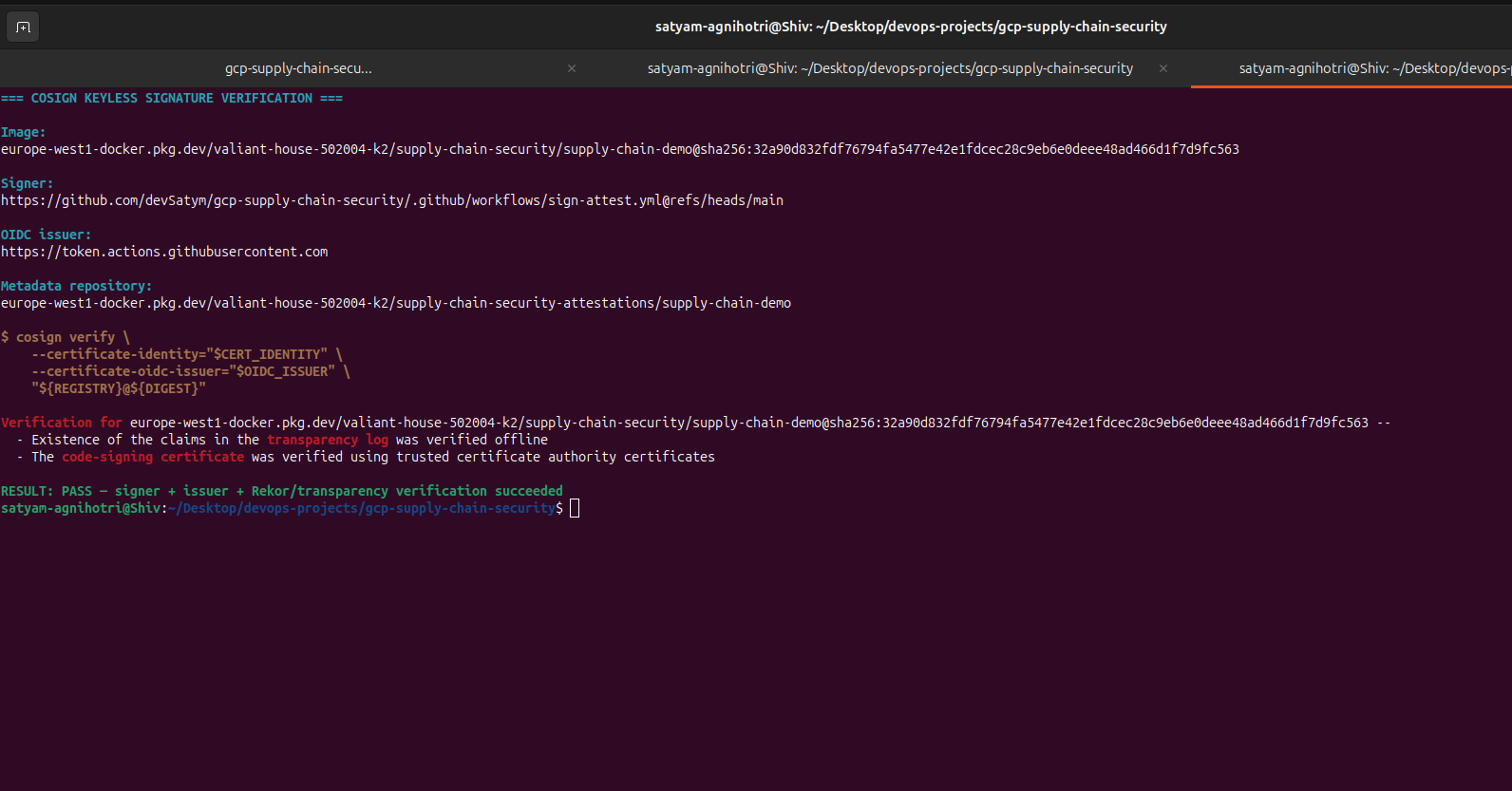
Evidence boundary: This standalone signature verification does not display SBOM or provenance predicate validation. The browser does not reauthenticate the capture.
The capture supports the pictured signature-verification result. It does not prove that the trusted workflow was uncompromised or that the application is safe, and viewing the image does not reauthenticate the artifact. Continue with the distinct SBOM and provenance claims: origin evidence alone does not make an inventory complete or a release approved.