A registry can contain many verified images. Selecting one to run is an authorization decision about desired state, not a side effect of image publication. The GCP baseline makes that choice through a reviewed manual digest update in the Helm chart. It has no automatic GitHub Actions promotion job.
Follow the same immutable identity
Build → D
D is an illustrative manifest digest, not a captured deployment.
Statements about D
Signature, SPDX SBOM and provenance bind to D.
Git selects D
Helm values retain the complete immutable identity.
Pod requests D
Policy evaluates that requested identity and its claims.
Build → D → Statements about Dsame digest D
Statements about D → Git selects Dreview selects D
Git selects D → Pod requests Dreconciliation retains D
Illustrative identity D represents one digest; it is not a recorded deployment digest.Text equivalent and limits
The build output identifies an OCI manifest by digest D.
The signature, SPDX SBOM and provenance bind claims to D; authenticity does not guarantee safety.
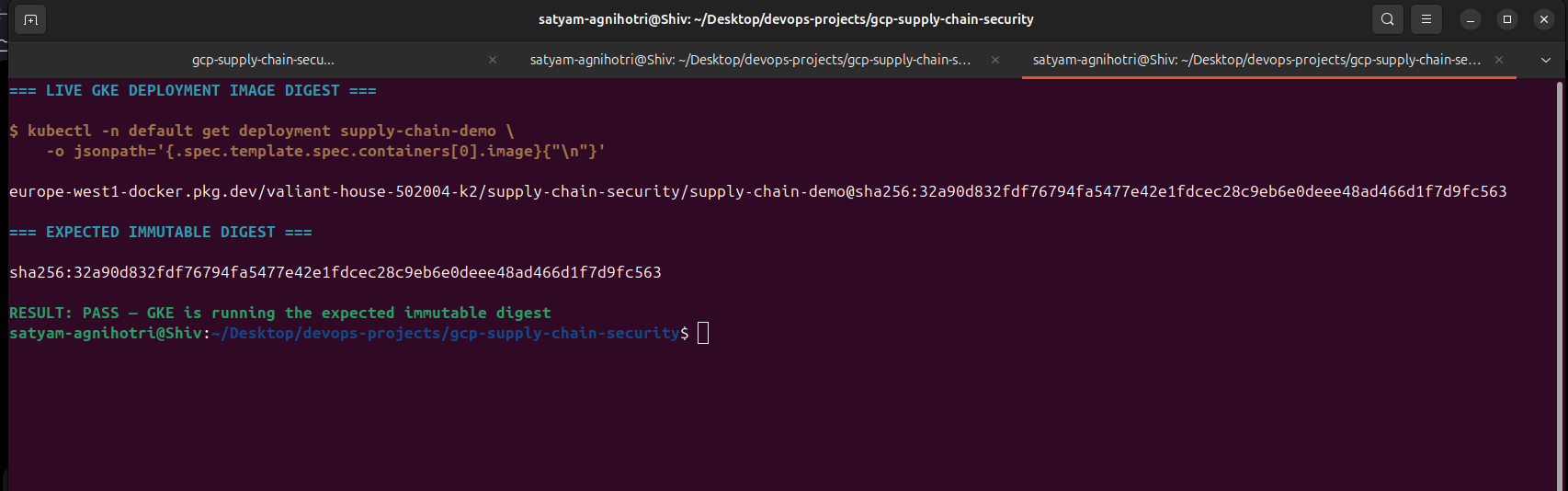
Helm values reference D rather than a mutable tag.
Admission checks the requested image D and the associated trust metadata.
Read the labeled relationships as the stated contract. Optional connections are dashed and explicitly labeled; comparisons do not imply a sequential handoff. This figure explains inspected code or recorded observations, not current cloud execution.
The Helm values contain a repository and the selected SHA-256 digest. The template renders that pair as repository@digest. An operator reviewing a promotion should connect the candidate digest to its source run, verification result, accepted scan exceptions, and intended rollout.
The source change that selects an image may be newer than the source used to build it. A promotion commit changes desired state; it does not rebuild the selected artifact. The historical CI audit attributes the deployed 32a90… digest to source e369771… and says 9bf574c… subsequently pinned it. Treat those as separate events even when another summary mentions a successful run on the promotion commit.
The later hardened main run produced a verified a0073… digest, while the status record deliberately retained the earlier digest pending reviewed promotion. A green pipeline therefore does not automatically change the workload.
The pictured Deployment specification selects the recorded digest. That field does not establish the running container’s imageID; the source selection and runtime identity need separate observations.
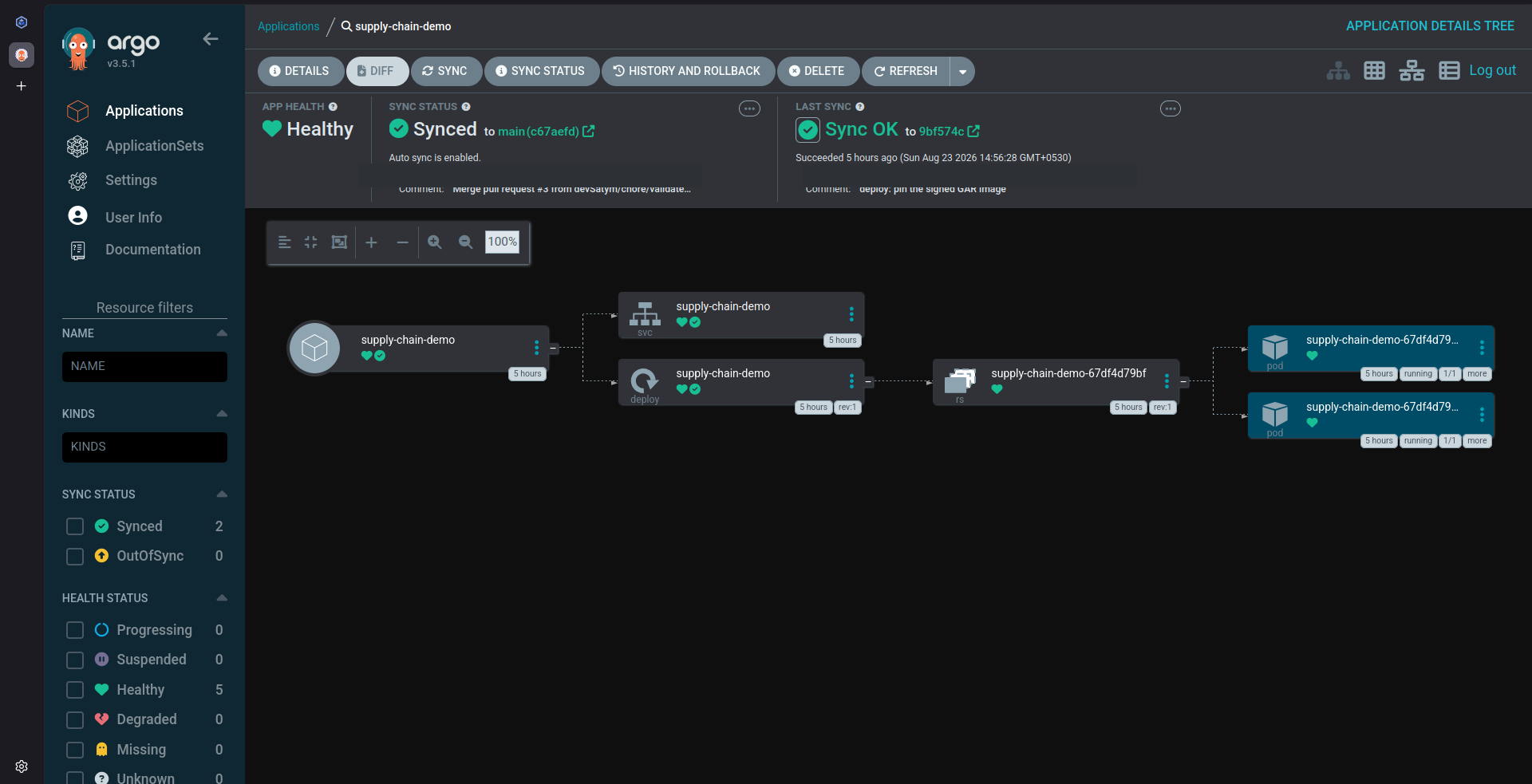
The Argo Application points to the canonical repository’s main branch and k8s/helm/supply-chain-demo, with release name supply-chain-demo, destination namespace default, and automated prune and selfHeal. Argo CD renders the chart and reconciles desired state into the cluster.
Argo CD establishes consistency with its configured Git source. It does not perform the policy’s signature verification. The Kubernetes API still sends the resulting in-scope workload through Kyverno admission. A chart rendering successfully or an Argo sync beginning is not proof that the Pod was accepted; policy rejection can leave the Application degraded or out of sync.
Self-healing also affects operational changes: a manual modification to an Argo-managed object can be restored to the Git definition. An emergency response must account for reconciliation before assuming a cluster-only edit will persist. The historical negative-test Application is separately configured without automatic synchronization to avoid endlessly retrying known denials.
The pictured application was Healthy and Synced to canonical main at capture time.
Recorded result: Capture shows Healthy, Synced to main(c67aefd), Sync OK to 9bf574c, two running Pod nodes.
Argo reconciliation captured on 2026-08-23; current sync c67aefd and last-sync 9bf574c are separate observations. Select the image for full resolution.
Key limitation: Healthy/Synced describes captured reconciliation, not cryptographic verification by Argo.
Transcript and provenance
Expected in this setup: Argo reconciles the selected Helm release and reports healthy workload resources.
Historical GCP, europe-west1; current environment not checked · observed 2026-08-23 · source revision c67aefdb7e140edf94213284bc2cb73a0b1d5a46
Selected visible labels:
APP HEALTH Healthy
SYNC STATUS Synced to main(c67aefd)
Auto sync is enabled.
LAST SYNC Sync OK to 9bf574c
Succeeded 5 hours ago (Sun Aug 23 2026 14:56:28 GMT+0530)
Two Pod nodes: Running 1/1
Full limitations
Healthy/Synced describes captured reconciliation, not cryptographic verification by Argo.
Current sync revision and last-sync revision are different visible fields; neither is automatically the artifact build revision.
The picture does not independently establish policy revision or all admitted image fields.
Visual review of original capture. Collection capture date attributed to docs/my-validation/README.md; this task did not rerun its cloud experiment. Unmodified original. Application status, public source revisions and timestamps retained; no user-info contents or credential visible.
The capture supports historical reconciliation and health. Its Git sync revision is not the image’s build revision, and a Healthy/Synced status does not establish approving-review enforcement.
This handbook describes reviewed manual promotion as the baseline’s intended operating procedure. Source alone cannot establish that every historical change received an approving human review. CODEOWNERS and an unapplied ruleset do not provide that proof. The meaningful observable configuration is that publication does not update the selected digest and that desired state is tracked in Git.
Rolling back desired state means selecting an earlier appropriate verified digest, not replacing the chosen tag with arbitrary bytes. Historical provenance remains associated with the artifact’s build source, while the rollback commit records a new deployment selection.
The original Application follows canonical main, which now implements Azure and no longer contains this GCP chart. A detached checkout of the GCP tag does not change the Application’s remote source. An owned reproduction must deliberately bind GitOps to the owned preserved source while aligning signing identity and federation; see first release.
Continue with the admission decision. The selected digest says what should run; admission asks whether this particular request satisfies the enforced in-scope image contract.