I hardened the trusted release path in the exact-verification commit. The change adds canonical-main guards and makes decoded signature and attestation fields determine success. A verifier needs a failure condition for a missing or mismatched claim; displaying a useful-looking field is not the same decision.
The historical CI evidence below is a later recorded execution of the hardened path. It identifies its own source revision and digest and is kept separate from the earlier artifact selected for the live workload.
Read the labeled relationships as the stated contract. Optional connections are dashed and explicitly labeled; comparisons do not imply a sequential handoff. This figure explains inspected code or recorded observations, not current cloud execution.
The patch guards the build/SBOM chain on canonical main plus a push or typed manual deployment confirmation. Dependent signing and verification are also main-bound. This keeps a PR build output outside the normal privileged chain.
In the final verifier, Cosign uses the exact expected sign-attest.yml certificate identity and GitHub Actions issuer. Shell steps use strict error handling. Parsed statements must contain a qualifying match; empty filtered output causes failure rather than producing a success summary.
Claim
Explicit CI acceptance condition
Image signature
Exact signer/issuer verification and expected manifest digest in the authenticated payload.
SPDX statement
Expected predicate type and at least one subject with the expected digest.
SLSA v0.2 statement
Expected predicate type and qualifying subject digest, GitHub runner builder, signing entrypoint, canonical source URI, current source commit and a matching repository material.
The any-match semantics matter. CI requires a qualifying subject and material; it does not establish that every array entry matches. A summary that prints the first subject is not the algorithm used to select a qualifying payload.
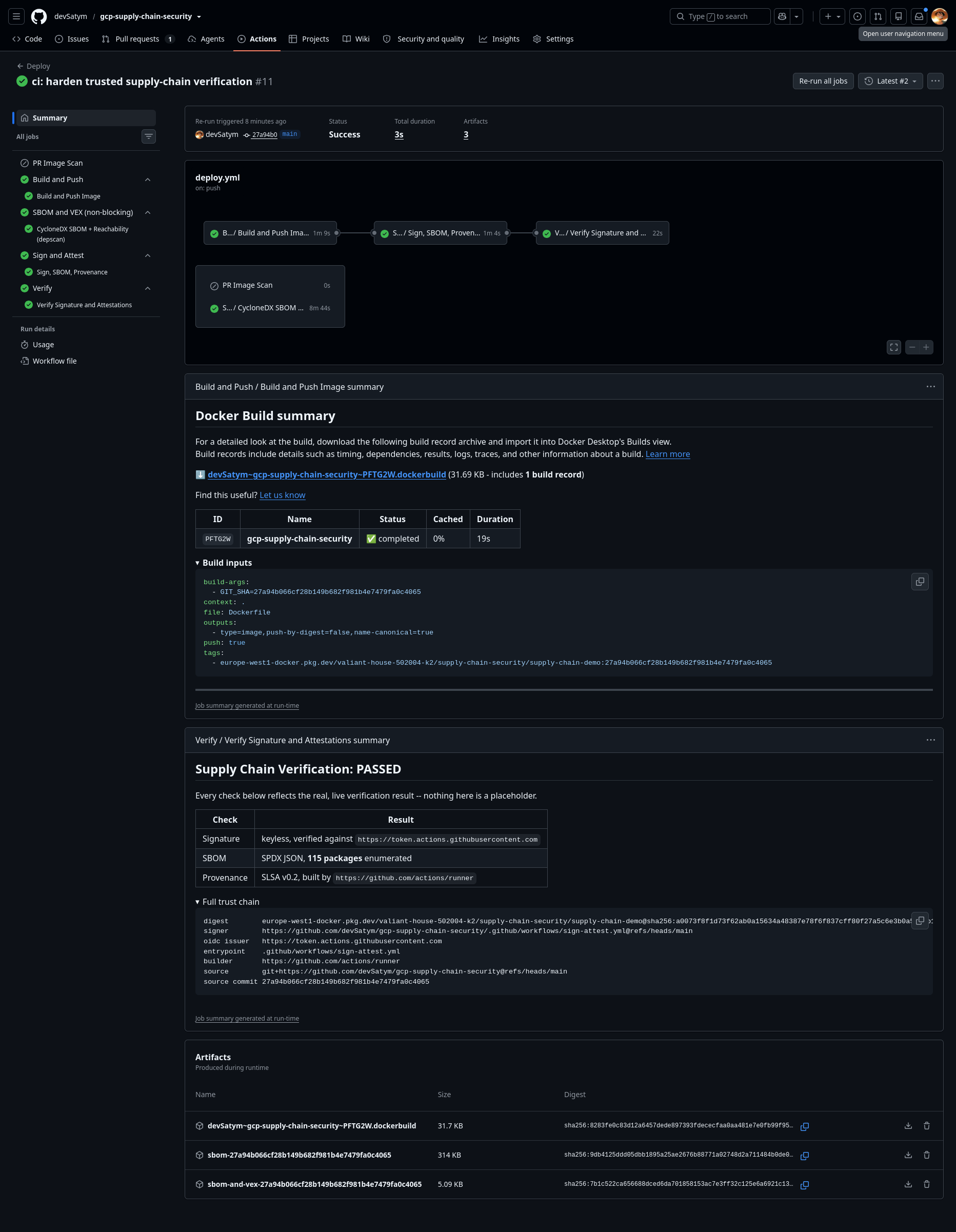
The main pipeline capture shows success for source revision 27a94b066cf28b149b682f981b4e7479fa0c4065. Its output belongs to artifact a0073f8f…, not the selected live 32a90d… artifact.
Recorded execution · accepted
The pictured main workflow completed its build, signing and verification jobs.
Recorded result: Capture shows Success for a main workflow at commit 27a94b0, with build, sign and Verify jobs green.
Captured main workflow for source revision 27a94b0; distinct from the accepted live-workload artifact. Select the image for full resolution.
Key limitation: This is a captured workflow attempt, not a newly observed Actions run.
Transcript and provenance
Expected in this setup: The main workflow builds/pushes, signs/attests and verifies its selected digest.
Historical GCP, europe-west1; current environment not checked · observed 2026-08-23 · source revision 27a94b066cf28b149b682f981b4e7479fa0c4065
This is a captured workflow attempt, not a newly observed Actions run.
The displayed artifact digest begins a0073f8f and differs from the 32a90d live-admission capture.
README run/revision context must not be substituted for the commit visibly shown in this image.
Visual review of original capture. Collection capture date attributed to docs/my-validation/README.md; this task did not rerun its cloud experiment. Unmodified original. Public canonical GitHub handle/repository, source commit and historical registry scope retained; no workstation metadata or credential visible.
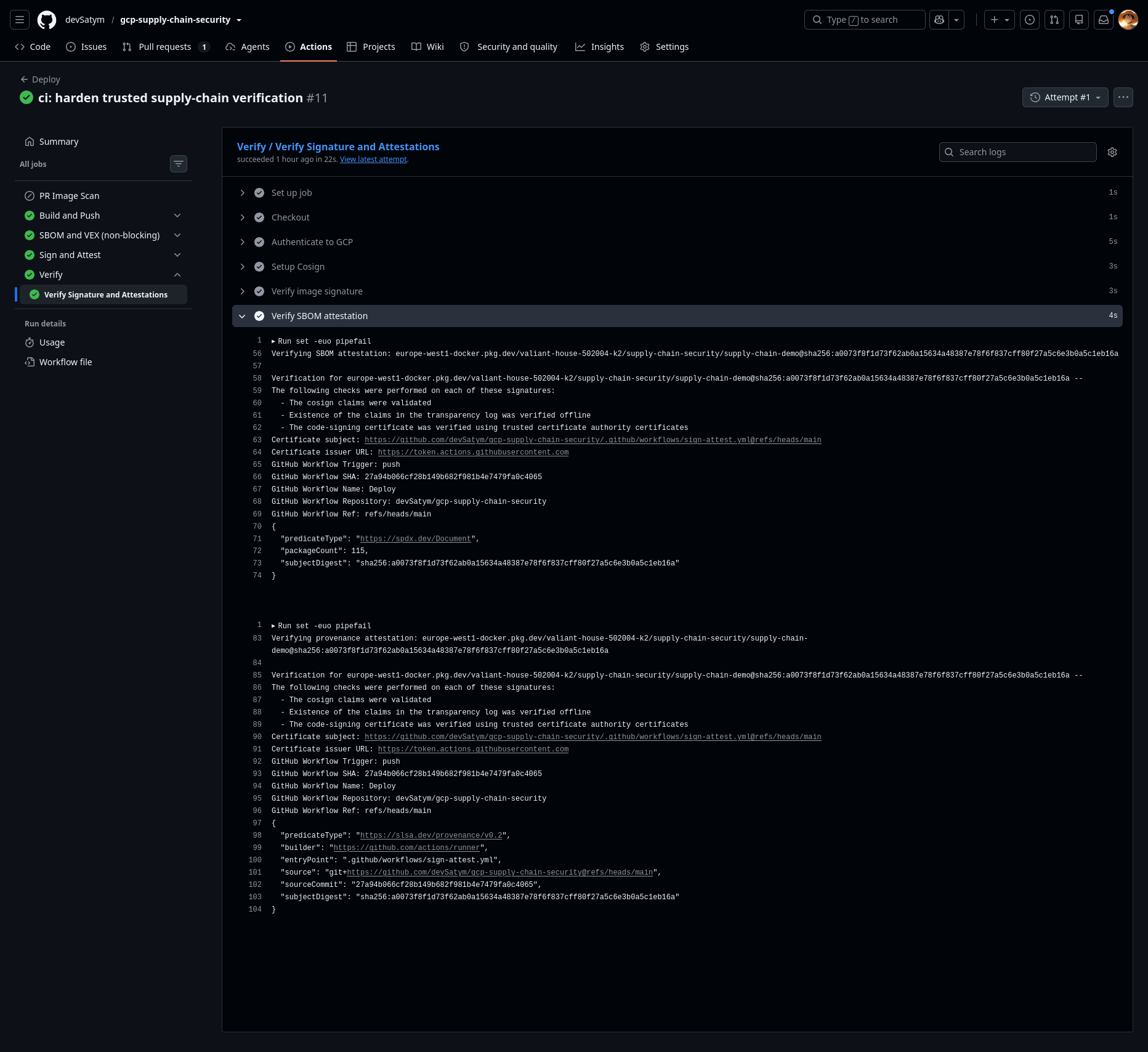
The related attestation capture shows packageCount 115 and the accepted provenance fields for that same source/artifact family.
Recorded execution · accepted
The pictured CI verification accepted authenticated SPDX and SLSA v0.2 claims for its digest.
Recorded result: Decoded verification output shows SPDX packageCount 115 and provenance builder/entryPoint/source/sourceCommit fields.
Historical CI output for a0073f8f…; verification confirms the captured claims, not an entire supply-chain assurance level. Select the image for full resolution.
Key limitation: Package count is this capture's output, not a measure of SBOM completeness or package safety.
Transcript and provenance
Expected in this setup: Authenticated claims identify the expected digest, signer, issuer, builder, entrypoint and source.
Historical GCP, europe-west1; current environment not checked · observed 2026-08-23 · source revision 27a94b066cf28b149b682f981b4e7479fa0c4065
Package count is this capture's output, not a measure of SBOM completeness or package safety.
SLSA v0.2 is a schema label; no assurance level established.
This digest differs from the later live-acceptance test digest.
Visual review of original capture. Collection capture date attributed to docs/my-validation/README.md; this task did not rerun its cloud experiment. Unmodified original. Public workflow identity, source commit, digest and historical registry scope retained. No credential or personal workstation path visible.
Those observations support the pictured attempts. They are not a newly observed Actions run, and this case does not copy their success onto the older live artifact.
Canonical-main restrictions are workflow guards. The GCP provider condition checks the repository, not ref or signing workflow. A changed OIDC-authorized workflow in the trusted repository remains a shared risk.
Admission repeats important checks but does not repeat CI’s explicit source-commit and material conditions. Its provenance rule checks builder, entrypoint and source URI. Neither verifier explicitly enforces every invocation parameter or a complete material inventory.
The approved workflow writes the provenance predicate itself. Authenticating that statement identifies its approved producer; it does not independently prove hermeticity, reproducibility or a SLSA assurance level. Likewise, a signed SPDX document and package count do not establish complete inventory or package safety.
Exact checks make the release contract reviewable: expected values and mismatch behavior are visible in one place. They also couple acceptance to the project’s selected source/workflow identity, so a legitimate migration requires coordinated changes rather than a relaxed matcher.
The retrospective lesson is to inspect both cryptographic verification and the post-verification predicates. A signature can be valid while the accepted subject, digest or source contract is wrong. See the full verification matrix for the CI/admission differences, and shared failure assumptions for what matching producer claims still cannot establish.